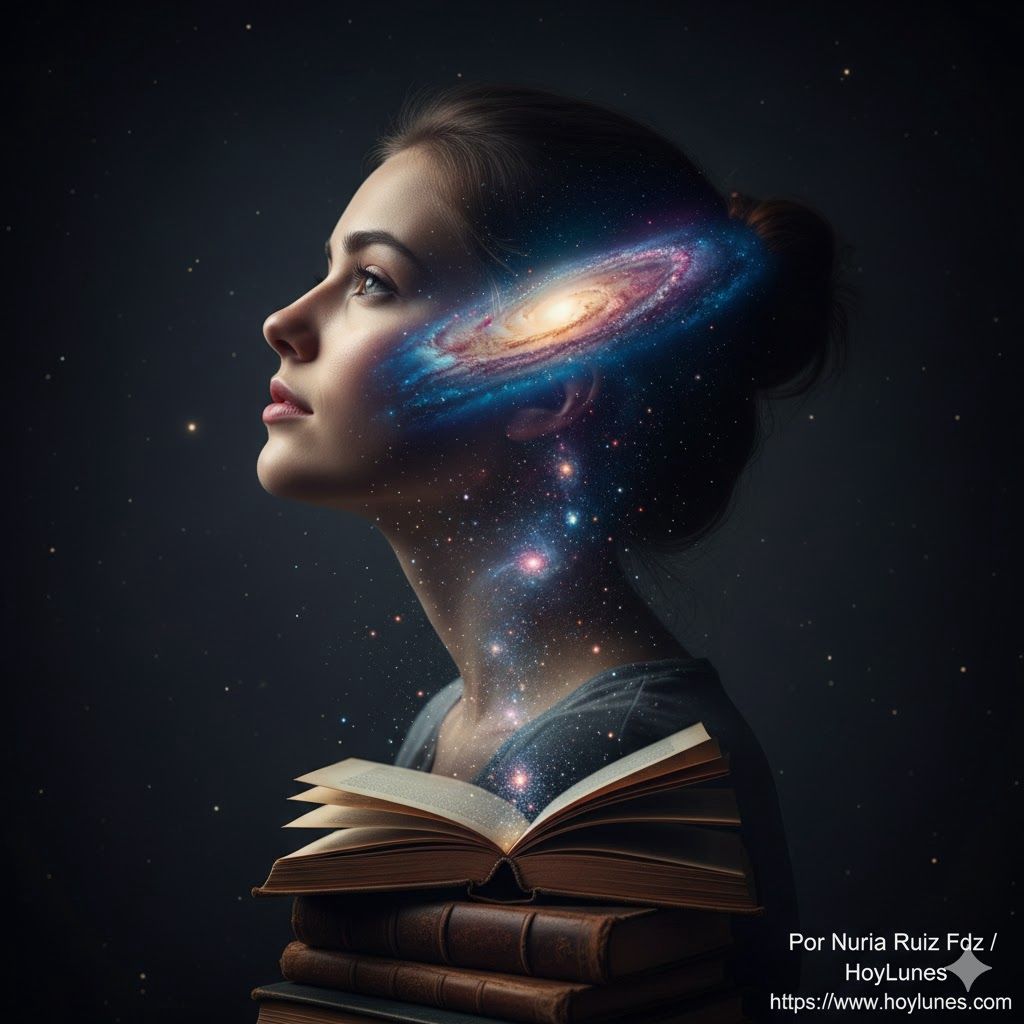
From my mother’s bookstore to Asimov’s “Foundation”: An introspective journey through the science fiction that shaped my curiosity, challenged my reality, and taught me that the most valuable passports are kept on bookshelves.
By Nuria Ruiz Fdez
HoyLunes — For as long as I can remember, science fiction has been much more than a literary genre to me: it has been a refuge, a discovery, and at times, a kind of secret religion. I began reading it at just sixteen years old, thanks to my mother owning a bookstore. I could get any book I desired, and I devoured every title as if they were hidden treasures.
I was so immersed in these readings that, instead of praying to God, I found myself praying to the universe for an alien to liberate me from my small, heavy earthly reality. These are the follies of youth that I now remember with a mix of laughter and tenderness, as if my teenage self had a secret pact with the stars. I felt that every book opened a door to possible worlds, and I wanted to walk through them all.
For a long time, my go-to books were undoubtedly those of J.J. Benítez. From a very young age, I plunged into the “Trojan Horse” (Caballo de Troya) saga. I remember how each volume was a world unto itself, filled with mysteries, time paradoxes, and historical details that forced you to imagine, to question, and to dream. But my passion didn’t stop there: I also devoured other iconic titles by Benítez, such as “The Envoy” (El Enviado), where the secrets of the universe blended with the protagonists’ daily lives; “Lucifer’s Rebellion”, which made me question morality and human history; or “The Fifth Column”, with its theories and enigmas that felt as close as they were unreachable. Each book was a passport to impossible places, a reminder that the seemingly mundane could contain infinite mysteries.
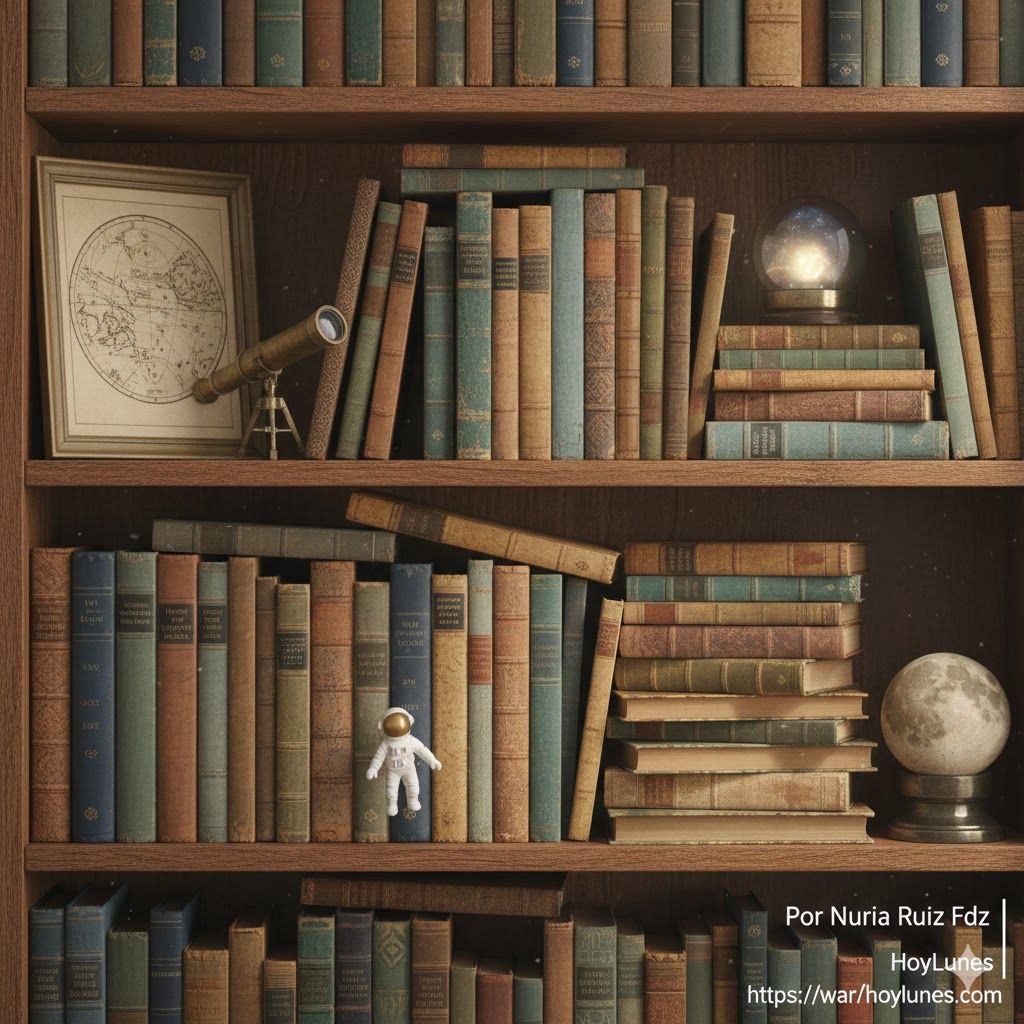
Simultaneously, the books of Erich von Däniken were a constant source of wonder. Works like “Chariots of the Gods”, “Gods from Outer Space”, or “The Gold of the Gods” taught me to look at ancient monuments, myths, and history in a different light: as if there were something more, something humanity was only beginning to understand. And, of course, the universes of Isaac Asimov—with the iconic “Foundation,” his “I, Robot” stories, and novels like “The End of Eternity”—introduced me to a more rational and structured type of science fiction, where logic and the laws of the universe were as fascinating as any UFO or inexplicable phenomenon I could imagine. I also fondly remember Aldous Huxley’s “Brave New World,” a visionary work about a future where humans are no longer born to parents but are created and conditioned by society—a reading that deeply impacted me for the way it combines imagination, social critique, and a haunting vision of tomorrow.
I must also mention Ray Bradbury and his unforgettable “Fahrenheit 451”, which taught me that science fiction could also be poetry, a warning, and a passionate defense of books; or Arthur C. Clarke, whose “2001: A Space Odyssey” opened my mind to a silent, immense, and profoundly philosophical cosmos. During my adolescence, these books were my sanctuary. I remember perfectly that in school they called me “the witch” because I spent hours talking about aliens, time travel, and robots with laws more intelligent than many people I knew. Today, with perspective and a bit of humor, they would surely define me as “the weirdo” or “the sci-fi geek”, and it amuses me to think how seriously I took it all back then.
After the age of twenty-five, I set science fiction aside for a while to explore contemporary narrative, poetry, and novels, trying to find my own voice. For over a decade, science fiction remained in the background—always present in my memory, but dormant.
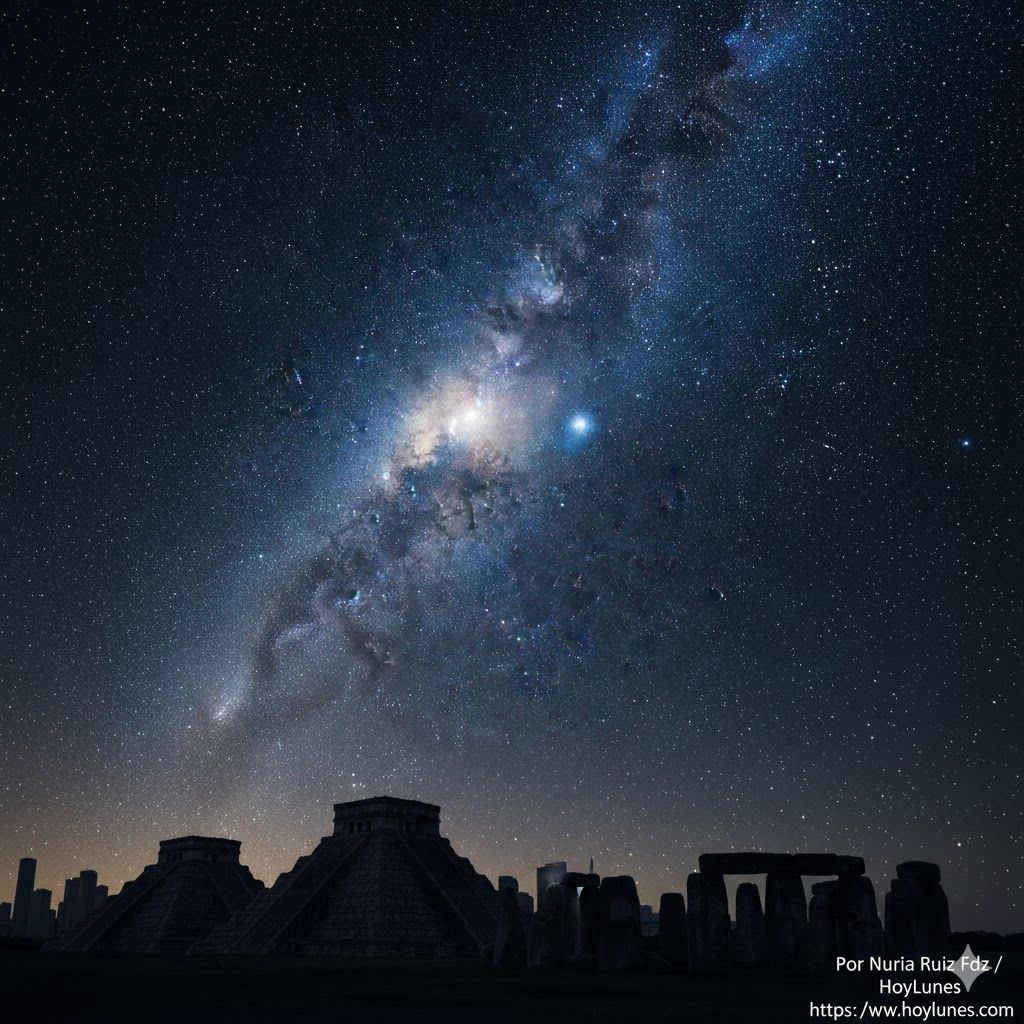
Then, I returned. Thanks to my students—many of them young science fiction writers—I have once again felt that tingle that only reading the classics can provoke. By seeing their stories, their dystopian worlds, and alternative universes, I have returned to myself. Yet, I cannot help but feel a mix of tenderness and surprise: many of these young creators build worlds without the culture of the classics, without having read those who first imagined these impossible universes. This is not a harsh criticism, but a reminder that every new world has roots; decades ago, someone already wrote about time travel, unknown civilizations, alien invasions, or alternative societies. When I speak to them of Asimov, Huxley, or Bradbury, I laugh on the inside: I feel like a “Grandmother of the Cosmos” telling interstellar war stories, reminding them that many of their “innovations” were imagined long ago.
Today, at over fifty years old, I smile remembering those moments, but I also feel gratitude. That young version of me taught me to dream without limits, to look for answers in the most improbable places, and to believe that my imagination could touch the stars, even if only with my fingertips. That same girl lives on in me, and thanks to my students and my re-readings, we find each other constantly.
Returning to science fiction has been, for me, a return to the essence of my imagination. It is remembering the thrill of opening a book and feeling that the entire universe is within my reach. And yes, I still look at the sky from time to time, hoping that somehow my whisper reaches some corner of the universe. It’s a silly whisper, perhaps, but full of emotion, tenderness, and that humor that only a passion for the impossible can provide.
Ultimately, science fiction is not just a literary genre. It is a journey, a school for the imagination, and a reminder that even when daily life is heavy or boring, we can always escape to infinite worlds and question everything with full freedom. For me, it is returning to my teenage self—the school “witch”, the geek who prayed to the universe—and rediscovering that there is still magic, mystery, and adventure waiting between the pages of a book.
As long as I keep reading Asimov, Benítez, Däniken, and the young people rewriting science fiction today, I know there will always be a universe ready to be explored, reminding me that imagination, when it is free, has no age.

`#NuriaRuizFdez` `#ScienceFiction` `#SciFi` `#Asimov` `#Storytelling` `#HoyLunes` `#IntellectualCuriosity` `#Humanity` `#RecommendedReading` `#IsaacAsimov` `#JJBenitez`